Introduction
When looking for a website partner, do you ever think “well they’re too cheap, they can’t be any good” or “they’re very expensive, you must get a really premium service for that kind of money”?
If so, you’re not alone. It’s natural to think there’s a direct link between price and quality. Spoiler alert – for websites, that’s not true. And in this insider’s guide, we’ll show you how and why.
You’ll discover how to avoid being ripped off, and how to ask the right questions to find genuine value.
You’ll learn how to select the right service wisely; to spend not one penny more than you need to, choosing a partner with higher standards to get superior results to your high-spending competitors.
Sound worthwhile? Then read on!
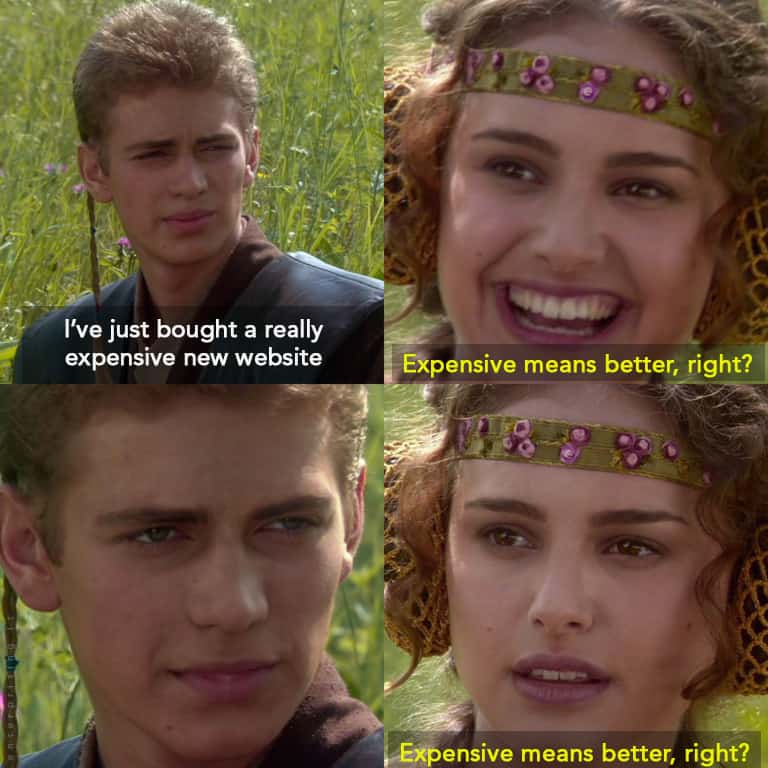
Exploding the myth: “You get what you pay for”.
Here’s how people most frequently work out what price to charge for a service:
- They work out how much it costs to deliver the service
- They add their desired margin
- Bingo – that’s the price they’ll charge you, the customer
It’s generally a decent model – but when it comes to websites, can you see the two big problems with that approach?
Problem Number 1: Higher costs are rewarded with more profit
The longer you spend doing something on a cost-plus-margin model, the more profit you make. So why would agencies expend effort on higher standards and more efficient processes?
There’s an unhealthy mantra that’s very common in the Web agency world: “If your client can’t afford it, you’re targeting the wrong clients”.
Notice how there’s nothing in there about our own responsibility as agencies – to work on our own costs, processes and efficiency so what we do becomes accessible to more customers?
Problem Number 2: Hiking your margin is rewarded (because people can’t really compare you)
Here’s some more advice that’s common for agencies – “double your prices; you’ll halve your customers but you’ll still be making all the money for half the work”.
We’ve even seen advice for new starters in the industry that says: “The biggest difference between a $2,000 website and an $8,000 website is saying ‘eight’ instead of ‘two’”.
In any normal product or service, it’s competition that prevents rampant margin inflation from happening. But competition is only possible when there’s an easy way to compare like with like.
That’s very hard indeed with websites – there’s a bewildering array of options for how they’re built and maintained, and their related digital marketing services.
Even as professionals, it’s hard to tell in advance how good a designer, developer or agency will be before seeing the quality of their delivered work, and to predict who will be the most effective in getting you customers.
So how can you, the customer, possibly compare like with like?
Answer: you often can’t, and this leaves you back with our old friend “You get what you pay for” as your only possible measure.
And as we’ve already seen – that’s just not true.
So can I find something that’s both cheap and good?
You certainly can! But just as there are multiple reasons a website build/service can be expensive, there are multiple reasons it can be cheap – and many of these are also not good news.
So here’s our quick checklist of things to look out for – both bad and good – when evaluating your next web partner on price.
Bad Reasons for being cheaper
| Reason | How you can tell |
| It’s a loss leader / lowball | Look at how much it costs for anything above the base package e.g. adding another email address. If there’s a long list of additional costs, they’re probably going to try to gouge more money out of you over time for things that are actually pretty essential. |
| You’re tied into a long contract | Can you walk away if you don’t like the site or find the ongoing service valuable? If not – why not? |
| They’re not actually experts | Are they simply using templates that look nice, without understanding website fundamentals? You can normally tell this from their existing portfolio. Ask us how. |
| It won’t work (i.e. it won’t attract new customers from searches) | Do they build/maintain the site in such a way that it actually attracts visitors? Everyone will say they do this, but do they give any guarantees? If not why not? |
| It’s not very flexible | If you ask for something a little bit different to their standard, will they struggle to deliver it? Do they try to constrain you to their own existing formats? |
| It’s “fire and forget” – done quickly and cheaply before moving on to the next customer | Do they offer a long warranty and a good-value ongoing maintenance plan? If either of those are “no” that’s a red flag – a well-built site should carry a good warranty and be cheap to maintain |
| It’s outsourced to cheap labour | Ask who’ll actually be doing the work – can you speak to them? You don’t want your requirements to be lost in translation, and quality control is hard when work is outsourced – it’s often skimped on, with poor results. |
| It uses cheap/free components under the hood | With very few exceptions, for software components “free” is bad news – because there is no money for ongoing development, so no way to keep the components secure and updated. It means something is likely to break in future, possibly with severe impacts. |
| It’s on a terrible hosting plan | Check the speed, and reputation for security, of their hosting partner. No information available? Walk away. A slow website costs you customers, and an insecure website could cost you your business. Cheap hosting is definitely a false economy. |
Good Reasons for being cheaper
| Reason | How you can tell |
| Their pricing is based on the value they supply YOUR business, not the amount of THEIR work | Ask them about how they calculate their pricing. If it’s cost plus margin – beware. Look for an answer like “We know customers need to achieve Y, so we set out to design our service X to deliver Y as efficiently and effectively as possible, to maximise their return on investment”. |
| They have mature project processes | Ask what project management tool/methods they use – they should have a ready answer for how they work efficiently with you |
| They provide clarity on what they need from you | Having a clear list of requirements (please supply X number of images and explain how you do Y) saves you time and effort, and is a good indicator that they know what they’re doing |
| They measure success in YOUR terms | Instead of measuring things like “the website was delivered”, they will care about things like your level of satisfaction, and the results you achieve with the site |
| They offer good ongoing care and maintenance | Are they happy to stand by their delivery with warranties, guarantees and reasonably priced maintenance services? This is a strong indicator that they are putting effort into the right things. Look for reviews that mention these things. |
| They’re happy to show you recent examples | A quality company should stand by every delivery they make. Look out for cherry-picked examples from a while ago, or links from “portfolio” pages that don’t actually connect to the sites in question. |
| The websites they deliver are fast and efficient | One of the simplest measures of development quality is the speed of a website. Ones that have been created lazily are often slow, which implies other shortcuts have been made too. It’s easy to measure website speed – ask us how. |
| They have reviews from longstanding clients | It’s easy to get good reviews from people who’ve just had something delivered. Instead, seek out reviews from people who’ve had a relationship with the agency for a longer period – how happy are they? Will you be in good hands? |
| They have mature support processes | Ask to see their support processes. How are tickets handled? What are their hours? What are their service targets? How do they ensure you are completely happy with your response? |
| Quality, quality, quality | Good quality costs LESS. Ask them about how they measure, and improve, the quality of what they offer. |
How does quality cost less?
That last point is really critical, and one of the key facts in this whole article. Good quality costs less.
In the world of commercial software, this is a well-known phenomenon – it’s just not widely adopted in Web agencies (yet).
Why is it true?
Quality of processes – when the agency is clear on their onboarding, design and delivery processes, it’s quicker and cleaner for you the customer; in turn, it’s much quicker (and cheaper) for agencies to work with.
Quality of tools/components – when using premium tools, software and components, the time taken to create with them (and support them in future) is much less. The costs of these premium tools are pretty negligible when servicing large numbers of customers, too – cheaper/free tools are a false economy.
Quality of delivery – Getting things “right first time” is much, much cheaper than things reaching the customer, not being right, then going back into development for another iteration.
Quality of maintenance – Prevention is far better (and cheaper) than cure. Proactive maintenance, security patching, uptime monitoring and other techniques will prevent costly interruptions to service that take time and effort to recover from.
Quality of change – How are changes recorded, planned and implemented? This is another area that can be hugely costly if done badly, but a surprising number of agencies have no process at all around this.
Quality of Support – Ensuring that the customer is completely happy with their response (so issues don’t drag on), always finding a root cause, and constantly looking for patterns in support tickets that could prevent future incidents. These are just some of the ways that quality support costs less.
These are just a few examples. There are a lot more!
So – how do I choose a genuine agency, that’s really good value for money?
We don’t want to give you the impression that all web agencies are sharks – far from it. We regularly come across agencies that do some or all of the above things very well, and take their commitment to quality seriously. Not everyone is out for a quick buck at the customer’s expense.
However it’s easy for even well-meaning agencies to cost more than they need to, through inexperience or just because it’s actually difficult to do some of this stuff well.
Please ask yourself, and your potential web partner/s, the questions from the above checklists – see how they respond. It will give you an idea of whether what they’re charging represents true value, and get you closer to being able to compare like with like.
And if you’d like us to look over any proposals for you, please send them over to us – we’ll give genuine, unbiased advice and compare what they offer to our own service for a point of reference.
Finally, if you really want to partner with a company that is built on the foundations of quality, honesty, transparency, and putting the customer first – then please get in touch with us. We pride ourselves on our high standards, and are proud that this allows us to offer you great services at lower-than-average costs.